How Cradle Scales Next-Gen Lab Automation With UniteLabs & Benchling
Dutch-Swiss biotech startup Cradle boosts lab efficiency 4x by integrating UniteLabs with Benchling to automate data and workflows. Cradle's lab scientists can now control experiments directly from Benchling, saving around 2,500 manual work hours per year.
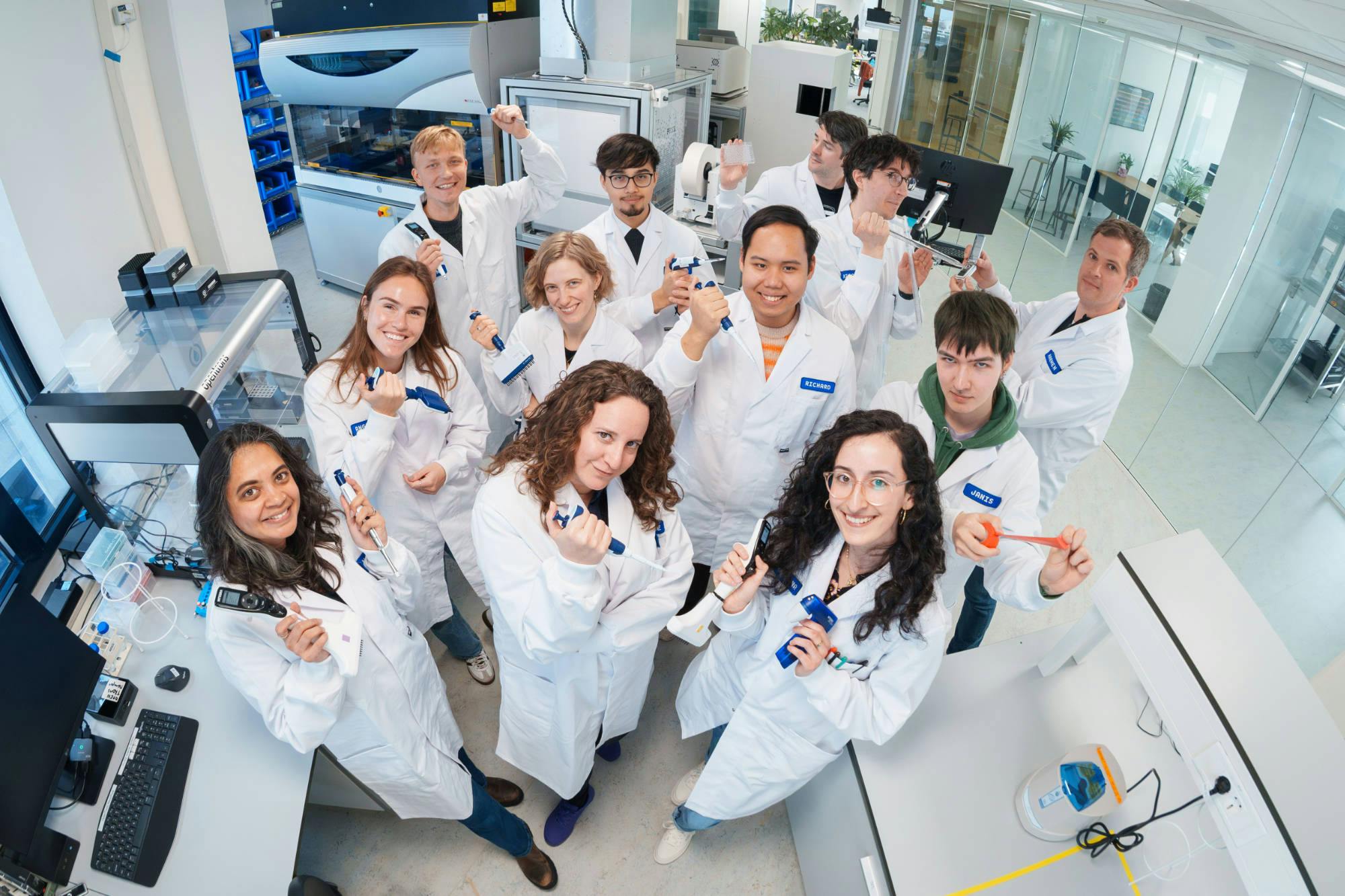
Cradle is a Dutch-Swiss biotechnology company that’s rapidly advancing protein engineering with an AI-based platform. Its software helps scientists to generate protein candidates faster, and make more breakthroughs in fewer experiments.
Uniquely, Cradle also operates a wet lab at its office in Amsterdam to improve its machine learning models. This lab can operate very fast, with round times as short as three weeks – and it wants to become the fastest lab in the industry, so that it can validate its machine learning (ML) models at lightning speed.
The challenge: High throughput, high friction
For experimental documentation, Cradle’s scientists use Benchling – a leading cloud-based ELN/LIMS for biotech R&D. While providing a unified digital environment for tracking experiments and results across teams, Benchling was effectively isolated from the lab instruments.
Despite Cradle’s modern lab hardware, the surrounding IT and data infrastructure created a bottleneck and daily friction due to massive raw data influx. The key challenges included:
- Manual data collection: Scientists needed to physically walk up to each lab instrument, extract data via USB drives and manually upload results into Benchling.
- Disconnected vendor software: The protein QC process required scientists to juggle four different vendor-specific software tools to complete a single run.
- Limited data searchability: Data was decentrally stored in heterogeneous formats, making it painstakingly difficult to scale workflows.
Cradle needed a way to smoothly automate workflows and move data at the same pace as experimentation, without forcing scientists to leave the environment they already knew and use daily. Which is where UniteLabs came in…
The UniteLabs solution: Benchling as the control center for all scientific data
Paired with UniteLabs, Benchling delivers scientists an active orchestration layer for lab workflows. With the UniteLabs platform, Benchling is elevated from a documentation system to an active orchestration layer.
A custom Benchling Canvas App, tailored to Cradle’s needs, allows their scientists to seamlessly trigger and manage complex lab processes, such as plate preparation, protein QC, and data normalization directly from Benchling’s user interface - no coding required.
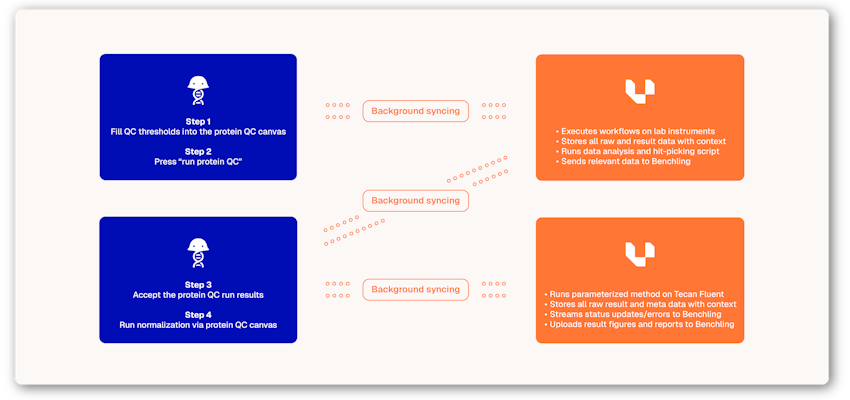
(Visualization of Benchling's integration with UniteLabs via bidirectional connectors)
For one particular workflow, Protein QC and normalization, a liquid handler and three analytical instruments were integrated into the UniteLabs platform via bidirectional connectors, enabling direct control and data flow without full reliance on vendor software.
Instrument orchestration, execution and data retrieval now run automatically in the background, while resulting data moves back into Benchling, nicely linked to the correct sample and metadata. A customized analysis layer processes incoming data in real time according to Cradle’s scientific requirements.
Python-based workflows select samples based on standardized, user-defined quality thresholds, ensuring that only samples of defined quality progress through the pipeline. Human-in-the-loop validation steps allow scientists to review edge cases and accept Protein QC results.
“By integrating UniteLabs into Benchling, the scientist is now finally put in the center of lab automation," says Daan van der Vorm, Research Associate at Cradle. "We can control entire lab workflows directly from our LIMS, including liquid handling and automated documentation without adapting our workflows to rigid vendor software.”
Outcome: A lab that scales with science
The result is a single, coherent system that frees valuable time previously spent on data management. It allows scientists to focus on experimental design, interpreting results and iterating faster.
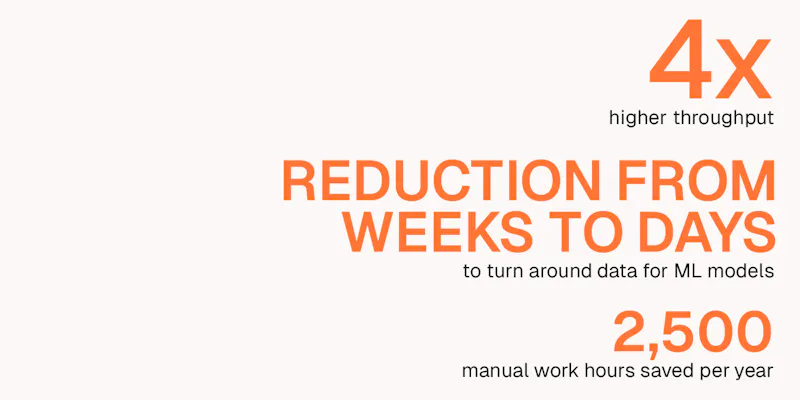
Instead of a 10-step procedure involving the operation of a patchwork of vendor-specific software, scientists can stay within Benchling and trigger workflows with just 3 clicks. Data flows automatically from the instruments into the pipeline and back into Benchling, fully contextualized by design and free from manual handling. Key results include a 4x higher throughput of data; a reduction from weeks to days to turn around data for ML models; and 2,500 manual work hours saved per year.
“To run a truly automated lab, you need to bridge the gap between instruments, LIMS and data lakes," says Harmen van Rossum, Co-Founder of Cradle. "Connecting UniteLabs with Benchling enables this and brings us closer to becoming one of the fastest labs in the industry by letting us iterate faster and generate high-quality data for our AI models.”
By eliminating error-prone manual data transfers and enforcing structured, machine-readable data capture, Cradle significantly increased data integrity, accessibility and reproducibility. Powered by UniteLabs' solution, the lab produces FAIR (Findable, Accessible, Interoperable, Reusable) data by default, which enables Cradle’s AI models to train directly on high quality datasets and accelerate protein engineering.
How was this achieved? By integrating data management and automation directly, UniteLabs bridges experimental design and automated data processing to where the experimental data already lives: in Benchling. It saves time, reduces errors and makes the lab feel scalable rather than fragile.
Ready to explore what’s possible with UniteLabs?
👉 Book a demo with Jan Titze, our Head of Growth