01 / 06

Vendor-Agnostic SDK
Control any liquid handler with one Python library. Test, build, and scale.
From low-level pipetting instructions to full workflows, orchestrate every system through code, not clicks.
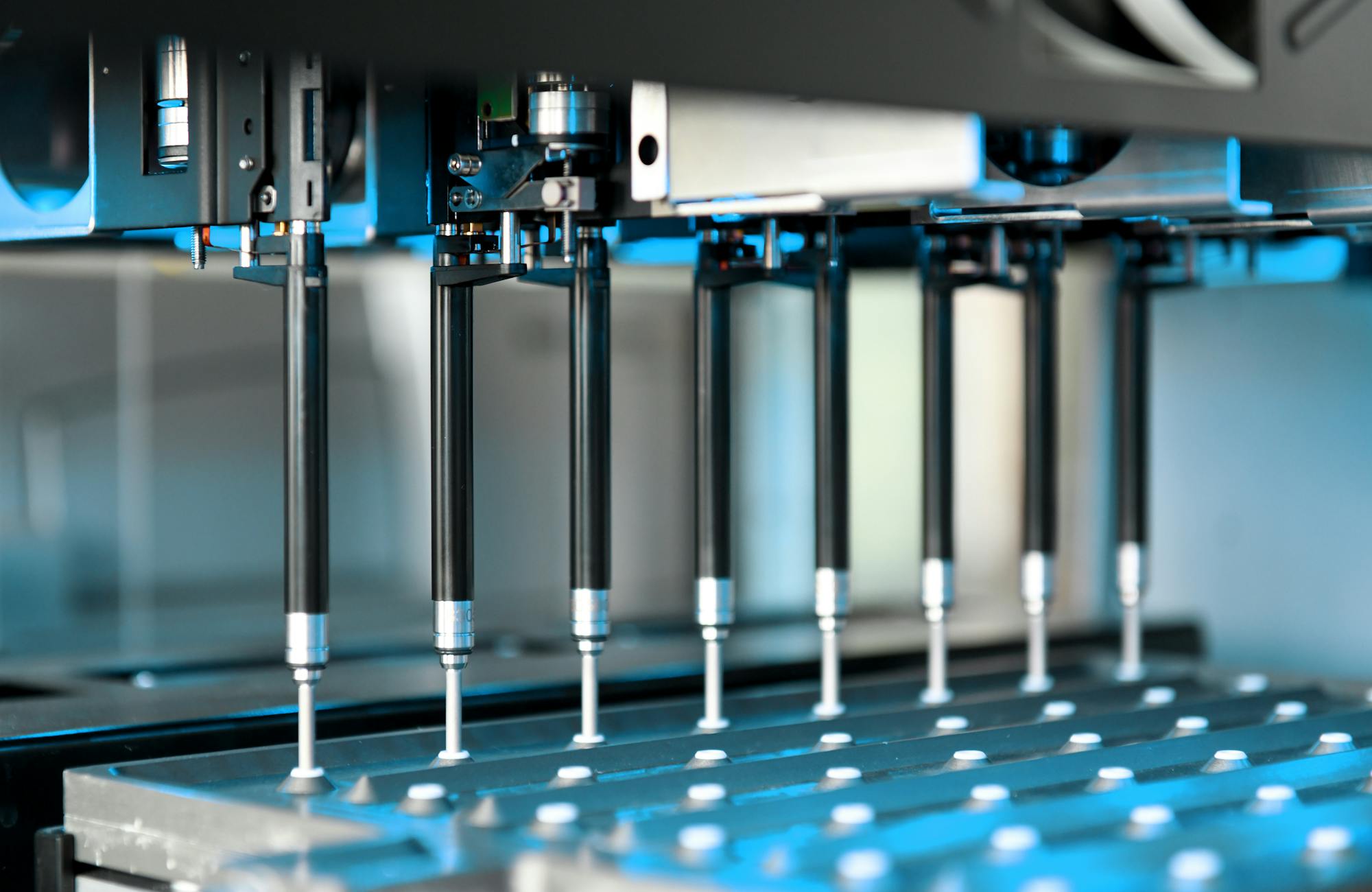
We bring modern software practices to the lab – making liquid handling faster to develop, easier to scale, and ready for whatever’s next.



Control liquid handlers with Python – not a GUI. Our SDK gives developers full command over their instruments, enabling scalable automation that fits right into your daily research.
Our platform connects to any instrument, regardless of brand or OS. Drive a Hamilton Microlab STAR, a Microlab VANTAGE, a Tecan Fluent or an Agilent Bravo from one Python library, and retire the clunky desktop apps.
Monitor, test and orchestrate your entire fleet of devices. Deploy new workflows, or instrument configurations instantly, and simplify onboarding with reusable templates and lab-as-code practices.
From firmware to the cloud, get everything you need to scale fast, integrate easily, and build workflows like a software engineer.
Control any liquid handler with one Python library. Test, build, and scale.

Use Git and CI/CD to version, review, and safely evolve every automation method.

Centralize deck layouts and liquid classes. Define, reuse, and optimize.

Unlock low-level control. Calibrate, tweak and fine-tune like never before.

Define decks as code and sync across fleets. Consistency, everywhere.

Control other hardware, connect to your ELN/LIMS - in one environment.
If you have more queries about liquid handling then contact us. We'd love to hear from you.
We support all major vendors, including Hamilton, Tecan and Agilent. Start with the connectors for the Hamilton Microlab STAR, Microlab VANTAGE, Tecan Fluent and Agilent Bravo, or check the Hub for the full list. If yours isn't listed, ask us: we can add new devices within weeks.
Software integrations talk to APIs. Deep integrations access the firmware.
Nope. Our setup is non-invasive and vendor-compliant.
It depends on your role. Scientists can trigger and run workflows from their existing ELN or LIMS without touching any code. For lab automators, Python is where the real power is — the SDK gives you full programmatic control over your instruments, with version control, reusable libraries, and everything you'd expect from a proper software stack. Workflow templates also help automators get up and running fast, without starting from scratch.
Yes. You can catch, resolve, and recover with robust built-in controls.
Absolutely. Link your tracking directly to each step of your protocol.
Yes. Use our SDK mock or simulator to safely test everything upfront.
Your workflows are written in Python, built on open standards, and owned entirely by you. There's no proprietary runtime, no black box, and no automation that only works inside our ecosystem. Whatever happens, your code stays yours.
Yes, and more of the process is automated than you might expect. Liquid class translation from Venus, for example, is roughly 90% automated — parameters tuned over years of operation can be bulk exported and converted to Python classes via script, rather than rebuilt from scratch. Standard vendor liquid classes are also available out of the box within the SDK.
For method structure, we use an AI-assisted pipeline to analyze and translate the bulk of existing workflows, with an automation engineer in the loop to validate key architectural decisions. The first method takes the longest, as it involves setting up shared libraries, repositories, and device configurations. After that, subsequent methods are significantly faster.
The honest answer is that migration isn't a one-click lift-and-shift — the scientific intent of each method carries over cleanly, but the implementation may look different in Python, often more elegant. We work with your team directly to scope the effort.
Liquid handling is where most automation starts, but rarely where it ends. UniteLabs connects your liquid handler to the rest of your lab — plate readers, centrifuges, robotic arms, incubators, and more — so you can orchestrate full multi-step workflows in a single environment rather than stitching together separate vendor tools. That's the difference between automating one instrument and automating the lab.
Discover the rest of our modular platform, built to connect, scale and simplify all of your lab.
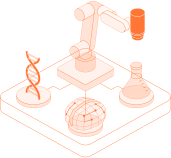
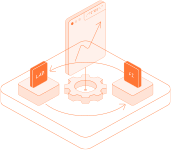
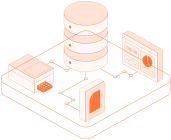
Capture, clean, and connect every datapoint for smarter decisions.
No pitch. No pressure. Just real conversations about how we can help your lab run better – today and tomorrow.