Lab Data Management, Explained
Struggling to wrangle your lab's data? The problem isn't the science, it's the missing layer for connecting systems. But hey, it's 2026 and there is a better way, as we explain.
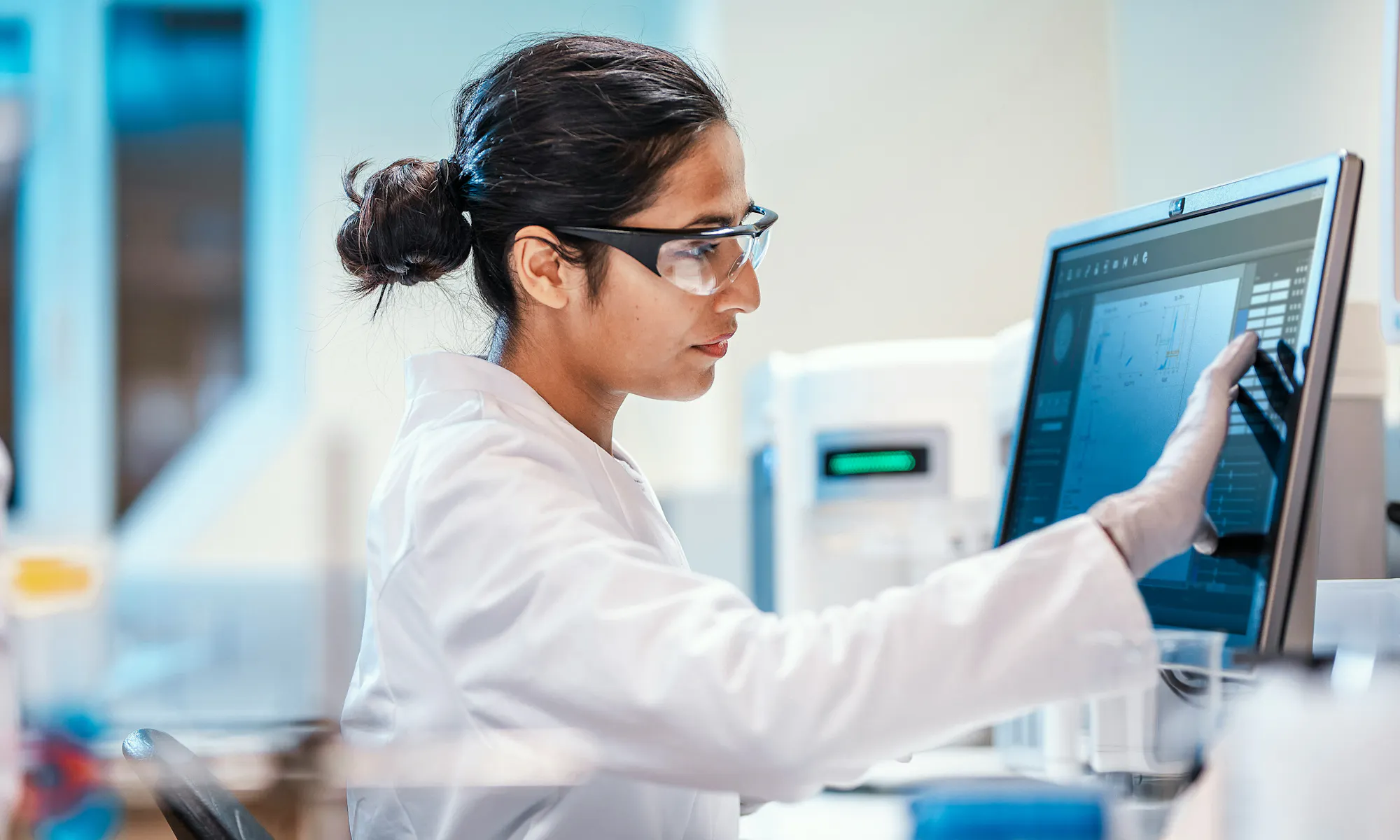
Lab data management is how a lab captures, organizes, and connects the data its instruments produce, from a plate reader's raw output to the metadata and sample lineage.
Problems with lab data commonly start when you have siloed instruments, manual handoffs, and data that you can't trust downstream.
So you're stuck re-keying numbers off a screen, chasing files across three systems, and second-guessing which version is the real one. Not ideal.
These issues can happen in well-equipped labs too: scientists might have to juggle four vendor software tools to complete a single QC run. Automation engineers try to maintain integrations that break every time a vendor pushes an update. Platform leaders invest heavily in instruments but can't get clean, structured data out of them.
Your lab isn't short on automation. It's full of it. Every instrument is its own automated island, running its own software, spitting out its own format. The trouble lives in the gaps between the islands, where data gets copied by hand, loses its context, and quietly goes wrong.
Most lab data management gets sold as storage. Buy the right system, the thinking goes, and your data gets tidy. That logic breaks on one fact: data born broken, one island at a time, can't be repaired downstream. A LIMS can't clean up what arrived wrong.
The solution is to fix it where the data is born, at the point of capture, by connecting the islands. Do that and the whole equation changes. You stop tidying data after the fact and start producing it clean: structured, contextualized, ready for a model to use the moment it lands.
>> Discover our lab data management solution <<
That's the part worth caring about. Clean data at the source compounds into speed, specifically the speed of your design-test-iterate loop. And loop speed is the thing the science really competes on.
This guide covers what good lab data management looks like in 2026, why most setups leak, and how to tell whether yours is slowing the science down.
What Is Lab Data Management, Actually?
Lab data spans a wide range of types, from sample metadata to assay results, instrument outputs, experimental protocols, quality control records, and clinical trial data. It's often generated by different instruments, in different formats, at different points in a workflow.
Effective data management covers all of it: how the data is captured (automatically, with context), where it's stored, how integrity is maintained, who can access it, and how it meets regulatory requirements. Ideally, this is all stored within a single data object for ease of use and integrity.
Many labs have some version of each of these in place. The question is whether those pieces form a coherent system or a patchwork of workarounds.
Key Benefits of Lab Data Management
Effective lab data management produces specific, measurable improvements:
AI-ready data, the day you capture it. A model is only as good as the data under it. Train the model on results scattered across vendor folders, half of them missing a sample ID, and it learns noise. Structured capture means that every result is linked to its protocol, instrument settings, and sample. That's data a model can act on. Labs that capture this way from the start have a lead that's hard to close, because the alternative is years of retrofitting.
Faster decision cycles. Better data handling drops ML model turnaround from weeks to days. Every lab competes on the speed of its design-test-iterate loop, so that compression is the business result, not a side effect. Faster loops = faster science.
Throughput multiplies. At Cradle, automating instrument capture and workflow orchestration through UniteLabs saved scientists 2,500 manual hours a year and turned a 10-step protein QC process into a 3-click operation. Lab efficiency went up 4x. That's the difference between validating models at the pace the science demands and waiting on data handling to catch up.
Data quality by default. Take manual handling out of the pipeline and transcription errors vanish. Structured capture produces FAIR data (Findable, Accessible, Interoperable, Reusable) with no cleanup step bolted on. Automated transfer systems routinely run error rates below 0.5%. Manual processes sit at 1-4%, and every one of those errors costs someone an afternoon.
Regulatory confidence. Automated audit trails mean you demonstrate compliance by running a report. For regulated labs, that cuts inspection prep sharply and closes the documentation gaps that keep QA leads up at night.
3 Challenges of Lab Data Management
This all sounds sensible so far, but what are the biggest challenges? Let's take a look:
1. Vendor Lock-in and Integration Gaps
Instruments from different vendors speak different protocols. Most ship with proprietary software designed for standalone use. Every new instrument potentially means another integration project, more training time, and more fragile connections.
But there is a better way. Robert Zechlin, Co-CEO of UniteLabs, says that removing vendor software from the middle and replacing it with Python code gives labs "better observability into what the instrument is actually doing, and makes it possible to control different instruments in a more consistent way".
2. Data Without Context
A result file that's disconnected from its sample ID, protocol version, and instrument settings is hard to interpret, impossible to audit, and unsuitable for AI or ML models. Scattered, unstructured data that's stored in folders without consistent naming conventions is a surprisingly common problem, even in sophisticated labs. Which is why UniteLabs stores it all as a single data object in the tool of your choice.
3. Scaling multi-stage workflows
Lab data management challenges compound when workflows span multiple sequential stages. With that in mind, a US-based genomics startup that set out to automate a full NGS pipeline asked UniteLabs to step in and build a data management infrastructure that could be extended without full rebuilds at each stage.
Lab Data Management System Types
The market uses overlapping acronyms for lab data management systems, which is rather confusing. Here's a quick overview of what each system actually does, and which lab situations they fit best:
Laboratory Information Management Systems (LIMS) center on sample tracking and chain of custody. Strong on operational management and compliance documentation; historically weaker on direct instrument integration or experimental flexibility. They're best for clinical labs, CROs, QC labs, and high-throughput testing environments.
Scientific Data Management Systems (SDMS) capture and archive raw instrument data in its native format, alongside the metadata that explains it: who ran the experiment, on which instrument, with which method and settings. They're best for regulated environments that need long-term data retention and audit trails.
What an SDMS does: It collects result files from instruments, usually by watching export folders, then indexes them so they're searchable and stores them unaltered with a full audit trail for as long as regulations require. In GxP labs, support for data integrity principles such as ALCOA+ and electronic records rules such as FDA 21 CFR Part 11 is usually the core requirement.
Where an SDMS falls short: Most SDMS tools work as archives. Data arrives after the run as a file export, so the system can only keep what the instrument software chose to write. If a sample ID was mistyped or a parameter never exported, the archive preserves the error faithfully. Few send anything back: they rarely start a run, pass results to the next step, or update your Electronic Lab Notebook (ELN).
Electronic Lab Notebooks (ELN) replace paper notebooks with structured, version-controlled, searchable records. They're often the interface that scientists interact with most, which is exactly why it matters whether they can also serve as the control surface for automation, not just documentation. They're best for research labs, academic settings, and any environment where protocol documentation and experimental records are central.
SDMS, LIMS or ELN? A LIMS tracks samples and their chain of custody. An ELN records what the scientist planned and did. An SDMS keeps the raw data those activities produce. Many regulated labs run all three side by side.
When you need an SDMS: If auditors ask for raw data years after a run, or your instruments produce large native files that must stay unchanged, an SDMS earns its place. If your bigger problem is getting clean, contextualized data out of instruments in the first place, fix capture first. An SDMS is only as useful as the data it receives, which is why structured, sample-linked capture at the source matters more.
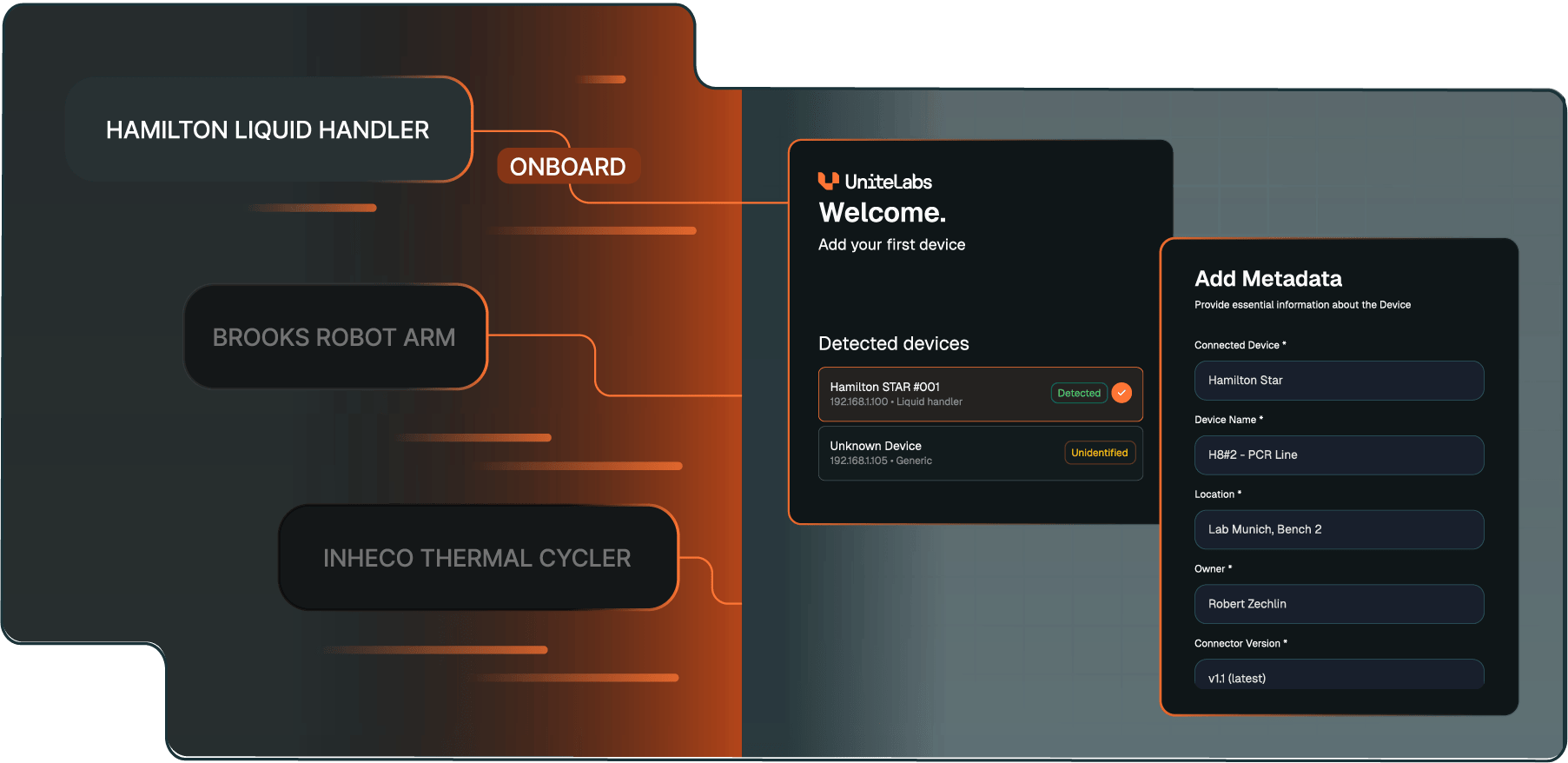
Integrated platforms and automation OS layers connect all of the above (instruments, LIMS, ELN, and data pipelines) through a single infrastructure layer. This is where most of the value is created, and where most implementations run into trouble when it's absent. These are best for labs running multi-instrument workflows, platform-heavy biotechs, and any other organization where throughput, data quality, and AI-readiness are strategic priorities. This is where UniteLabs solutions fit best.
Most labs don't need to choose between these categories. They already have one or more in place. The more pressing question is how to connect what they already use to the instruments and workflows that generate the data.
A Note on Lab Data Analytics and Dashboards
Data capture is only half the picture. The other half is being able to act on what you've collected.
Modern lab data management platforms increasingly include built-in analytics and reporting tools that go well beyond exporting a CSV.
Real-time dashboards make it possible to monitor experiment status, instrument outputs, and quality metrics as they happen, and deliver alerts. Trend identification across runs helps to surface systematic issues (instrument drift, reagent variability, operator-specific patterns) that batch-level review would miss.
Automated quality thresholds take this further: rather than a scientist reviewing every result, the system flags edge cases and only surfaces those that require human judgment. Code-based workflows can select which samples progress based on user-defined criteria, routing only qualifying samples through the pipeline. Human-in-the-loop validation steps handle the exceptions.
For labs feeding data into AI or ML models, this analytical layer matters as much as the capture layer.
High-quality, structured, contextualized data that arrives in real time (rather than batched weekly after manual cleanup) is what makes model training fast and reliable. At Cradle, the shift from manual to automated data handling reduced ML model data turnaround from weeks to days.
Methods of Lab Data Integration
Better lab data integration is easier said than done. Here's what to expect:
Legacy instrument integration is often the hardest part. Older instruments may lack APIs, export only proprietary file formats, or require vendor software as an intermediary. The practical options are: middleware that translates between the instrument and your platform; file-watchers that ingest exports automatically; or firmware-level access via modern connectors. The latter is significantly more robust: firmware-level connections provide real-time control and sensor data, not just end-of-run file exports.
Cloud vs. on-premise is less binary than it used to be. Most modern platforms support hybrid architectures — cloud execution for workflow orchestration and data storage, edge deployment for running workflows locally when latency or connectivity is a constraint. For regulated environments with strict data residency requirements, private deployment options (SOC 2-compliant, on-premise or private cloud) are increasingly standard.
What to expect during implementation depends heavily on how much existing infrastructure there is. A realistic timeline for onboarding a new automation platform from instrument integration through to running production workflows can now be measured in weeks, not months, if the platform is genuinely vendor-agnostic and the implementation team is experienced. The first milestone is usually a single functioning workflow on a single instrument. From there, expansion is additive rather than disruptive.
Practical integration checklist:
- Does the platform connect to your existing ELN or LIMS bidirectionally, not just as a file export destination?
- Can it connect your specific instruments, and how long does a new connector take to build?
- How does it handle errors mid-run? Does it notify, log, and allow recovery — or does it fail silently?
- Does data arrive already linked to sample and metadata, or does reconciliation happen downstream?
- Is the workflow logic version-controlled and auditable?
How to Choose the Right Lab Data Management Solution
Here are a few questions that cut through vendor comparisons:
Where does data currently get stuck? The answer is usually somewhere specific. A particular instrument with no integration, a format that nothing downstream can read, or a manual export step. Start there, not with a comprehensive platform overhaul.
What do scientists already use? Adoption matters more than features. A solution that lets scientists stay in their existing LIMS or ELN to trigger workflows will be used consistently. One that requires context-switching for every run will require workarounds.
How vendor-agnostic is it, really? Platforms that require proprietary integrations for every new instrument create ongoing dependency. Look for bidirectional connectors that give direct instrument control across vendors, without routing through proprietary software.
Can it scale without a rebuild? Start with one workflow. Add instruments. Expand to multiple workcells. The architecture should support incremental gains.
Beyond the above questions, you should look for a few recurring infrastructure characteristics, which are achievable now, and will serve you well in the years to come:
Build on FAIR data principles from day one. FAIR data (Findable, Accessible, Interoperable, Reusable) is increasingly a baseline expectation. Labs that retrofit FAIR compliance incur a significant cost in time and data quality. Labs that capture structured, contextualized data by default from the start don't have to.
Adopt industry data standards. Frameworks like Allotrope are gaining traction because they solve the interoperability problem at the schema level. Data that uses a common structure can move between instruments, platforms, and organizations without custom translation. Building on established standards now prevents proprietary lock-in later.
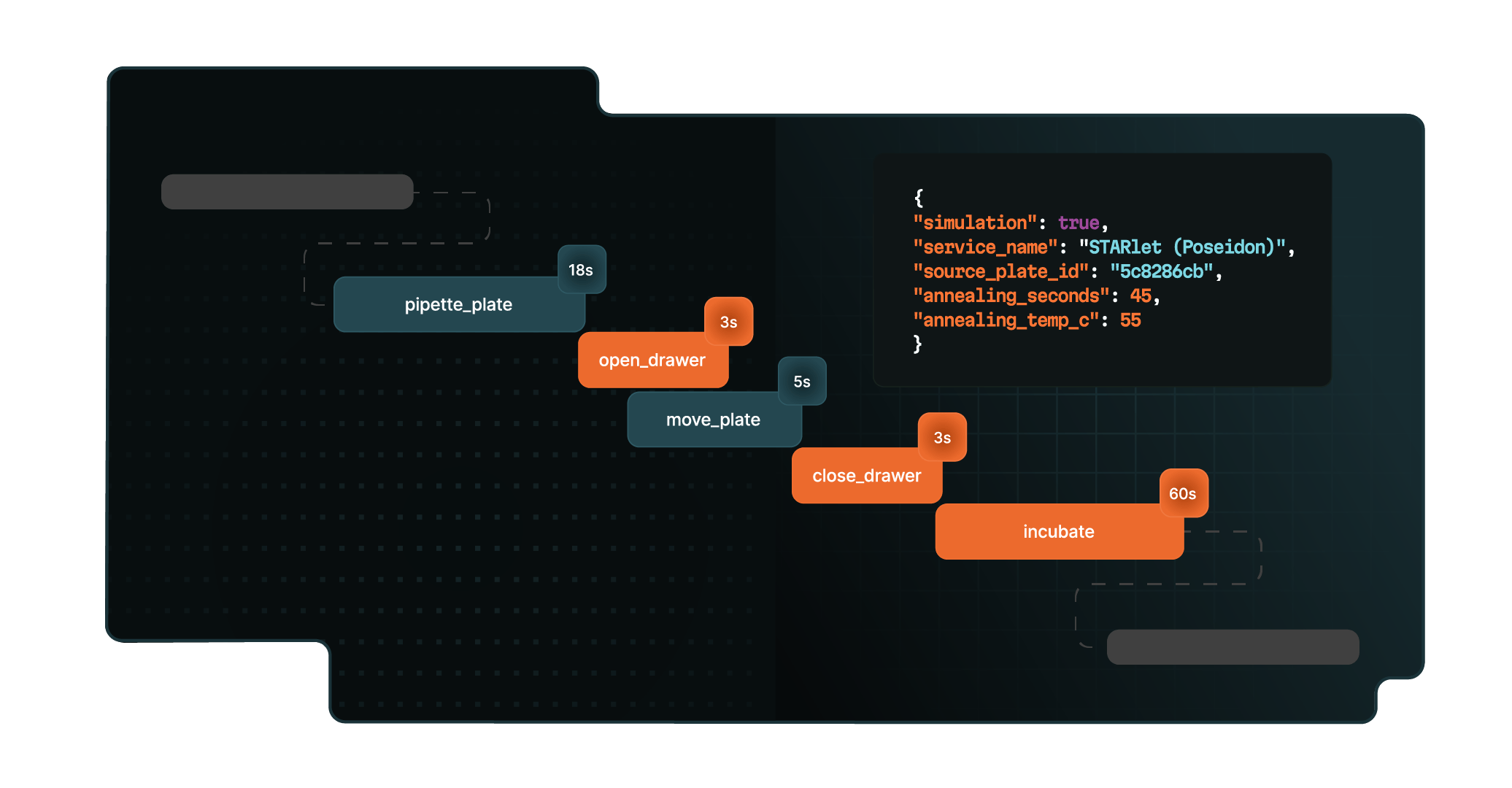
Choose modular over monolithic. Write workflow logic once, in code, and deploy it across instruments. Build reusable libraries. Version-control everything. This approach compounds: each workflow you build adds to a foundation that the next workflow can use. Monolithic systems that require full commitment upfront don't compound, they accrete technical debt.
Make your lab readable and writable for AI. AI agents are coming that can design experiments, execute them, interpret results, and iterate with minimal human intervention for routine decisions. That requires infrastructure where devices expose their capabilities in machine-readable formats, workflows can be triggered programmatically, and data arrives with enough context for a model to act on it. Labs that build this infrastructure now have a head start that is difficult to replicate later.
The co-founder of a US-based genomics startup working toward the most automated next-generation sequencing lab in their sector described the goal clearly: an environment where method development to production is 10x faster, and where the platform scales with the science rather than constraining it.
The Bottom Line
Lab data management isn't a back-office concern. The quality of a lab's data infrastructure directly determines how fast it can move, how reliable its results are, and how confidently it can scale. This includes moving toward the AI-driven workflows that are increasingly defining competitive drug discovery, protein engineering, and genomics.
The gap between where most labs are and where they could be is often an integration and implementation challenge: connecting instruments that don't talk to each other, getting data out of vendor software silos, and building workflows that scientists will actually use.
Start with this question: where does the data actually get stuck? The answer will tell you more than any vendor comparison matrix.
Discover UniteLabs
Want to find out more about the UniteLabs platform? Head to our Solutions Overview.
Read our latest case study to discover how biotech startup Cradle boosted lab efficiency 4x by integrating UniteLabs with Benchling to automate data and workflows.
Check out our 'Lab of the Future Manifesto' to discover our vision for the next decade, based on first-principles thinking.
Or simply book a call with one of our experts to find out how we can transform your lab!